Curated selection
Quiet Euphoria. Tereza Strnad
Karin Svoboda, collector, art curator and adviser on interiors and development
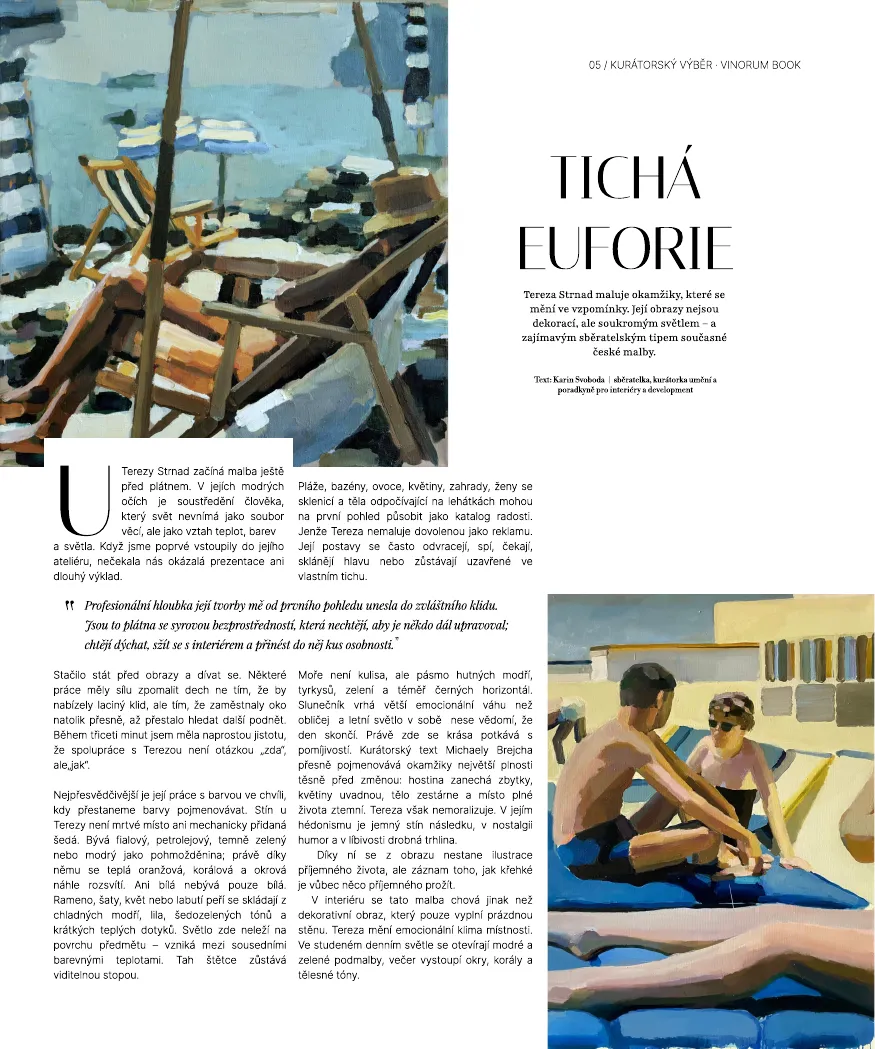
With Tereza Strnad, painting begins before the canvas. Her blue eyes hold the concentration of someone who perceives the world not as a collection of things, but as a relationship of temperatures, colours and light. When we first stepped into her studio, there was no showy presentation awaiting us, no lengthy explanation. It was enough to stand before the paintings and look. Some of the works had the power to slow one’s breathing — not by offering cheap calm, but by occupying the eye so precisely that it stopped searching for anything further. Within thirty minutes I was entirely certain that working with Tereza was not a question of “whether”, but of “how”.
A school of colour, not a school signature
Tereza Strnad was born in Prague in 1978 and from 1999 to 2006 studied in Jiří Sopko’s painting studio at the Academy of Fine Arts. This schooling is legible in her work above all as the courage to entrust colour with the role of a painting’s load-bearing structure — not as an inherited signature. Tereza does not first build a verbal interpretation and then paint to fit it. She trusts that a painting has its own language, and uses words sparingly, so as not to rob it of intimacy and mystery.
Her path, moreover, did not unfold at a pace dictated by the market. After a long pause she returned to painting in 2017, and in the summer of 2018 she rented a studio. It is precisely this mature second beginning that can be felt in her current paintings: there is no student’s need to prove skill in them, but an awareness of what can be left out. In recent years the continuity of her exhibitions has grown stronger — from repeated participation in Art Prague, through the solo exhibition Home Sweet Home at the Gallery of the Faculty of Civil Engineering of the Czech Technical University (ČVUT), to a presentation in Rijeka and the group exhibition Barva času (The Colour of Time), dedicated to Jiří Sopko and his students.
A shadow that is not black
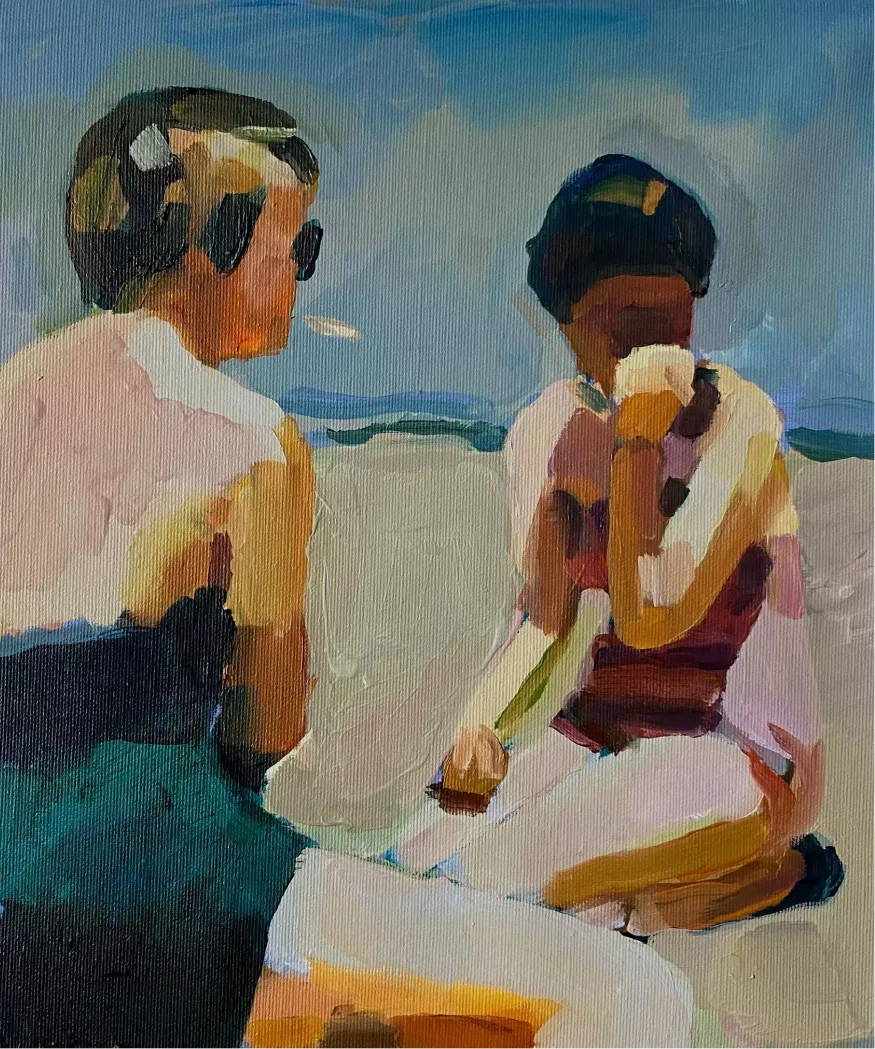
Her work with colour is at its most convincing the moment we stop naming the colours. In Tereza’s paintings a shadow is neither a dead spot nor a mechanically added grey. It tends to be violet, petrol, deep green or blue like a bruise; and it is precisely thanks to it that the warm orange, coral and ochre suddenly light up. Nor is white ever merely white. A shoulder, a dress, a flower or swan’s feathers are composed of cool blues, lilacs, grey-greens and brief warm touches. Light here does not lie on the surface of an object — it arises between neighbouring colour temperatures.
The brush remains visible and each stroke keeps its physical trace. Some edges are precise, others dissolve; faces are often not psychological portraits but colour masks that leave room for the viewer. Tereza can simplify a figure without depriving it of presence. This is a rare discipline: the painting does not look unfinished, but open. Every further detail could be one explanation too many — and therefore a loss.
Summer without the postcard
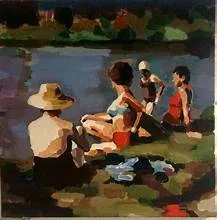
Beaches, swimming pools, fruit, flowers, gardens, women with a glass in hand and bodies resting on sun loungers may at first glance read like a catalogue of joy. Yet Tereza does not paint holidays as an advertisement. Her figures often turn away, sleep, wait, bow their heads or remain enclosed in their own silence. The sea is not a backdrop but a band of dense blues, turquoises, greens and almost black horizontals. A parasol carries more emotional weight than a face, and summer light carries within it the knowledge that the day will end.
It is here that beauty meets transience. Michaela Brejcha’s curatorial text names precisely those moments of greatest fullness just before change: a feast leaves remnants, flowers wilt, the body ages and a place full of life grows dark. Tereza, however, does not moralise. In her hedonism there is a faint shadow of consequence, in her nostalgia humour, and in her appeal a small crack. Thanks to it, the painting never becomes an illustration of a pleasant life, but a record of how fragile it is to experience anything pleasant at all.
The painting as emotional architecture
In an interior, this painting behaves differently from a decorative picture that merely fills an empty wall. Tereza changes the emotional climate of a room. In cool daylight the blue and green underpainting opens up; in the evening the ochres, corals and flesh tones come forward. Beside wood, stone, linen or brass, the paintings do not compete for effect, because their luxury lies not in the surface, but in painterly intelligence.
Their rawness calls for restraint. A heavy decorative frame could tame part of their energy; they look best left free, or perhaps in a subtle shadow-gap frame. A painting should not be chosen to match the sofa. On the contrary, a good work should create a tension in the space that was not planned in advance, and gradually become its most natural part. It is not the final accessory of an interior, but its emotional architecture.
“I don’t invest much in art, but here I saw a very concrete goal: a painting I would want to buy with my next pay cheque.” — Aline Eremeeff after her first visit to the studio
Why she is interesting right now
With art, the best moment to buy often comes before the market agrees on quality. With Tereza Strnad I see several significant signals at once: a solid academic background, a recognisable signature, thematic continuity, a growing exhibition presence and a primary market that is still accessible. Her work is no longer a promise without a past, yet it is not yet weighed down by the price of an established consensus.
A publicly traceable secondary market is only beginning to take shape, and there is far too little data available for a serious price forecast. This needs to be said openly: this is neither short-term speculation nor a promise of automatic returns. That is precisely why I recommend her as a long-term collector’s acquisition — a work one should want to own even if no auction record came along for several years. Investment potential is an added possibility here; the primary value remains the quality of the painting and its ability to hold its own before one’s eyes every day.
What I would choose for a collection
For a first acquisition I would look for a work from the summer, seaside or swimming-pool cycles, because it is in these that Tereza’s coloured shadow, the figure and her ability to capture time meet most convincingly. Medium and large formats allow her signature to breathe fully; small paintings, by contrast, are more concentrated and intimate, and can be an excellent entry point into her work. I would choose the strongest painting first, not the one that best matches the current palette of the apartment. A truly good acquisition should tilt an interior slightly off balance — and then hold it together for years to come.
For each work it is advisable to keep the invoice, precise details of the technique, date and dimensions, a good-quality photograph, the exhibition history and a certificate of authenticity. Tereza includes a certificate with her paintings and also welcomes personal visits to her Prague studio. In my view, such a visit is essential: a photograph conveys the motif, but not the energy of the colours, the scale of the brushstroke or the way a painting responds to distance. Only before the original can one tell whether a painting has merely caught one’s interest, or whether one has already inwardly made it one’s own.
Quiet euphoria
Some paintings make an impression; others settle within you. Tereza Strnad can do both. Her painting is a quiet euphoria — so private and yet so much yours that you want to keep it to yourself and, at the same time, show it to everyone who walks in. It recalls a first infatuation: you cannot yet explain it precisely, but you know for certain that something in your inner world has shifted. And it is precisely in this that I recognise art worth collecting. Once it is hung, a room is not merely more beautiful; it is more personal, deeper and truly yours.
CONTACT
Tereza Strnad | Prague studio by appointment | terezastrnad.com | Instagram @strnadtereza
Printed edition
Related articles
 Art that gives a home confidenceSix artists whose works enter an interior not as decoration, but as personality.
 Lil Mirage. Lukáš Novák: glass with emotion and collector’s weightWhen I choose art for an interior, I am not looking for an object that merely fills an empty wall or obediently repeats the shade of the sofa. I am looking for a work that…
 David StrauzzThe second look is part of the work