Vertex Glossary
AWE. On things worth returning to
When did you last feel like a grain of sand — and, paradoxically, more yourself than ever before?
Karina Svoboda, Vertex Group Development
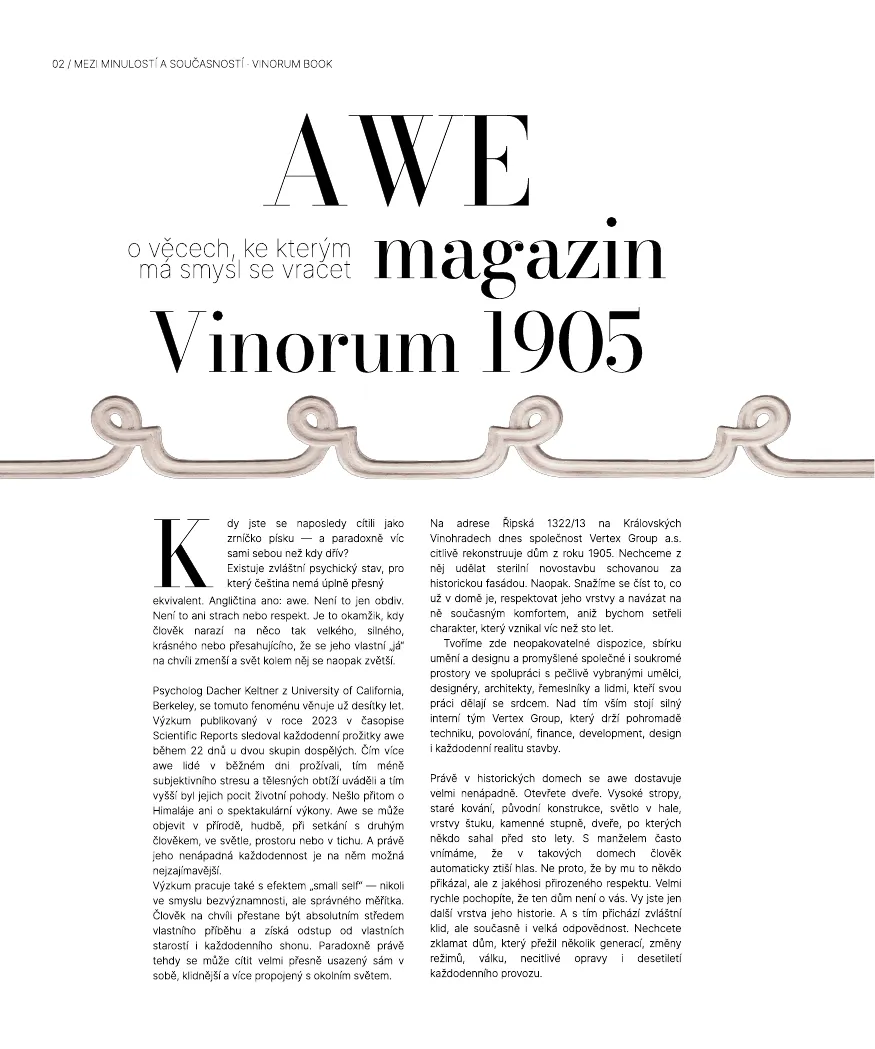
There is a peculiar state of mind for which Czech has no exact equivalent. English does: awe. It is not mere admiration. Nor is it fear or respect. It is the moment when we encounter something so vast, powerful, beautiful or transcendent that our own “self” shrinks for a while, and the world around us grows larger.
The psychologist Dacher Keltner of the University of California, Berkeley, has studied this phenomenon for decades. Research published in 2023 in Scientific Reports followed everyday experiences of awe over 22 days in two groups of adults. The more awe people experienced in an ordinary day, the less subjective stress and fewer physical complaints they reported, and the greater their sense of well-being. This was not about the Himalayas or spectacular feats. Awe can arise in nature, in music, in an encounter, in light, in space or in silence. And it is precisely its everyday quality that is perhaps the most interesting thing about it.
The research also works with the “small self” effect — not in the sense of insignificance, but of the right scale. For a moment, we stop being the absolute centre of our own story. And paradoxically, it is precisely then that we may feel most firmly settled within ourselves.
I know that feeling from old houses
At Řipská 1322/13 in Královské Vinohrady, Vertex Group a.s. is carefully restoring a house built in 1905. We do not want to turn it into a sterile new build hidden behind a historic façade. Quite the opposite. We are trying to read what is already in the house, to respect its layers and to build on them with contemporary comfort, without erasing the character that has formed over more than a hundred years.
Here we are creating one-of-a-kind layouts, a collection of art and design, and thoughtfully conceived shared and private spaces, in collaboration with carefully chosen artists, designers, architects, craftspeople and people who put their heart into their work. Above it all stands Vertex Group’s strong in-house team, which holds together the engineering, permitting, finance, development, design and the day-to-day reality of the building site.
It is in historic houses that awe arrives most quietly. You open the door. High ceilings, old ironmongery, original structures, light in the hall, layers of stucco, stone steps, doors that someone touched a hundred years ago. My husband and I often notice that in houses like these one automatically lowers one’s voice. Not because anyone asks you to, but out of a kind of natural respect.
You very quickly understand that the house is not about you. You are merely another layer of its history. And with that comes a curious calm, but also a great responsibility. You do not want to let down a house that has survived several generations, changes of regime, war, insensitive repairs and decades of everyday use.
Perhaps that is exactly why a good restoration of a historic house cannot be done purely by spreadsheet. Excel will calculate the costs, the return, the square metre and the schedule. But it will not tell you when it is better to save an original element than to replace it, why it makes sense to refurbish something that could more cheaply be thrown away, or why it is sometimes worth investing time and money in a detail that most people will never consciously notice.
And yet it is precisely these details that decide whether a space feels true.
Awe in material
At Řipská we work with historic floor tiles, original proportions, decorative craft elements, wood, metal, glass and stucco. We deliberately commissioned two independent expert surveys so as not to underestimate a single important detail of the house. One reads the history, the archive and the architecture; the other goes technically beneath the surface of the structures. Only together do they allow us to make decisions with both respect and responsibility.
For me, this is one form of awe: realising that before you stands something with a longer memory than your own. Something you do not merely adapt to the current trend, but pass on.
And it is here that, for me, psychology and development meet. A good space need not overwhelm a person with ostentation. It can make them smaller for a moment, in the right way. Remind them of scale, time, craft, continuity, and the fact that they are neither the first nor the last to pass through the place.
The ocean, Tarifa and the wind
I know a similar, perhaps even deeper feeling from the place where my husband and I reconnected and together fell for the ocean — windswept Tarifa in southern Spain, where we took up kitesurfing. There, on the Atlantic, in twenty-five knots of wind, you really are just a grain of sand. Humble, tiny, and yet in a curious way closer to yourself than anywhere else. Water, wind and horizon very quickly strip away everything inessential. You stop wrestling the world for control and begin to sense the rhythm of nature, which is greater than you.
After surfing we sit in a small café of perhaps twenty square metres, surrounded by sand dunes, pines and the scent of freedom. And suddenly you can take joy in something as elemental as a drop of drinking water. In ordinary shade. In a warm meal. In sitting beside someone with whom you share the same wind, the same falls, the same tiredness and the same joy.
Tarifa taught us a particular kind of humility. Not the humility that diminishes a person, but the kind that returns them to their proper place. The ocean will not stop for you. The wind will not change direction. Nature owes you nothing. And precisely in this way it reminds you of what is real.
Then I return to the building site and the feeling comes again, like déjà vu. Only in a different material.
Instead of the ocean, you have old masonry. Instead of the wind, time. Instead of an endless horizon, a history that began long before you and will continue after you.
And perhaps that is why the moments when we feel like a small grain of sand are, paradoxically, the moments when we are closest to ourselves.
What Vinorum 1905 takes from this
We do not want to build Vinorum 1905 on nostalgia. We do not want to pretend it is 1905. We want to preserve what has real value and complement it with the best we can do today — in art, design, technology, comfort and craft.
That is why a collection of works and objects is taking shape, why we work with people who have their own signature, why we look for craftspeople who know how to repair rather than replace, and why a single detail sometimes prompts a far longer debate than economic logic would advise.
AWE is not a business model. But it is a good corrective for the ego.
It reminds us that strong development need not be the kind that leaves the biggest signature on a house. Sometimes it is the kind that knows exactly where not to sign.
A hundred years underfoot
Why historic floor tiles are among the smallest details of a house — and at the same time one of the reasons Vinohrady commands its price
In Vinohrady, the value of a house often reveals itself before you even open the door of an apartment. In the entrance. In the door handle, the proportions of the portal, the stucco, the light on the staircase — and in the floor. Historic floor tiling is a discipline of its own: it consists of small ceramic squares, yet together they define the character of the entire house. Hundreds of shoes pass over them every day, hardly anyone looks at them consciously, and yet we notice very quickly when they have been replaced with something too new, too perfect and too catalogue-like.
That is precisely why, at Řipská 13, the restoration does not begin with choosing a pattern. It begins with reading the house.
Before repairs begin, we have to find out what we actually have
With historic houses it is increasingly important to commission a historical building survey. In practice, depending on its scope, it costs around CZK 50,000, but set against the value of the information the investor gains, it is an exceptionally sensible item. It is not an administrative formality. It is a map that separates the valuable original layers from later interventions, explains how the layouts evolved, and tells you what is worth saving, what to restore, and where the house can be sensitively complemented with contemporary technology.
At Řipská 13 we deliberately did not want to rely on a single opinion. We therefore had the house examined by two independent surveys from different professional perspectives: a historical building survey by PhDr. Michal Patrný and Ing. Markéta Musilová from 2024, followed by a structural and technical survey by NV Engineering from January 2025. One reads the archive, the building’s development, its architecture and decorative craft details; the other opens up the structures, measures, probes and verifies their actual technical condition. It is the combination of both perspectives that gives us confidence that we will overlook neither a detail of historic value to the house nor a problem that may be hidden beneath the surface.
The historical survey reveals something rarer today than ostentation: authenticity. The house has changed surprisingly little since 1905, and practically all of its surviving architectural and decorative craft elements date from the time of its construction. We therefore respect the original articulation of the façade, the glazed entrance doors with wrought-iron grilles, the coloured sandblasted and etched glass in the doors and on the half-landings, the granite steps, the wrought-iron staircase balustrade with its wooden handrail, the stucco of the entrance corridor and of the stair-flight soffits, and the surviving door panels. This is not decoration we want to imitate. These are the original layers of the house, which are to be refurbished, restored or — where saving them is no longer technically possible — replaced with a replica faithful in material and form. The authors of the survey state explicitly that the richly decorated corridors and staircase escaped later modernisation in a rarely authentic condition.
A detail that would be hard to design today
One of the most beautiful moments in the whole house is, paradoxically, something very small: the window of the maid’s room on the first floor. The survey describes it as one of the most remarkable details of the house — with an Art Nouveau stucco surround of foliage and tendrils, a mascaron with a girl’s head and a wrought-iron grille with a sunflower motif. Yet on its street façade the house is conservatively Neo-Renaissance. Inside, however, in 1905 Art Nouveau is already clearly making its entrance. It is precisely this layering of styles that gives an old house a depth that simply cannot be bought from a catalogue.
And then there are details that are almost cinematic. On the parapet there is still a stucco cartouche with the letter H — probably the monogram of the first builder and owner, Alžběta Hrabě. In the cellar, a walled-up passage to the neighbouring house has survived, probably created around 1943 during makeshift alterations of the cellars into air-raid shelters. And in 1927 the then owner tried to add another storey and a partial attic to the house, but the municipal authority refused. The history of the house is thus not an abstract story. It is written directly into the masonry.
The floor as an imprint of 1905
This is where the historic floor tiling belongs. According to the historical building survey, the entrance corridor of Řipská 13 has its original four-colour tiling of orthogonally laid square tiles, forming schematic quatrefoils with a double border along the walls. The same tiling continued into the entrance hall and part of the corridor leading to the courtyard.
For us, this is the starting point. We do not choose a retro pattern on impression. We build on the house’s specific historic composition.
The current laying plan therefore works with a 16 × 16 cm format, a 3 mm joint and a combination of the shades RAL 7044, RAL 1013, RAL 3005 and, in some compositions, RAL 9011. The historic tile itself is approximately 15–17 mm thick. On the 1st floor both a grooved and a smooth variant are used; on the upper floors, smooth tiles. The design was prepared by the OFSTONE team led by Ing. arch. Jan Smejkal and Ing. arch. Karel Trachta.
Why 16, 17.5, 19 or 20 centimetres?
Historic tiles had no single universal format. Old floors were made in different workshops, with different pressing moulds and drying and firing techniques, and the dimensions could vary even after firing. That is why in old houses we encounter modules of around 16 cm, 17 to 17.5 cm or around 19 cm, while current production often also works with a nominal 20 × 20 cm format.
A difference of a few millimetres is no cosmetic trifle. With a regular ornament it can decide whether the border meets the door exactly, whether the centre of the motif sits on the axis of the corridor, and whether the floor reads as a carpet or as a collection of trimmed pieces. That is why the laying plan matters as much as the tile itself.
How to make a floor that will last another century
What is most fascinating about historic floor tiles is the way they are made. They were produced as a dense, highly vitrified unglazed ceramic body. The pattern is poured into auxiliary stencils upside down: the individual parts of the ornament are made of fine silica sand coloured with minerals and elements — manganese for reddish-brown tones, for example, cobalt for black, selenium for green and chromium for blue. Only then is the tile pressed at high pressure and fired. The coloured layer reaches at least 4 mm into the body of the tile, so the motif is not merely a surface decoration and can survive more than 150 years of use. The floor therefore does not age by losing its pattern. It ages together with the material.
That is exactly why we support the people who keep this technique alive. With historic floor tiles, it is not just about ceramics manufacturers. It is about the custodians of a craft that works with the hand, the mould, pressure, minerals and firing in essentially the same way as more than a hundred years ago.
And the price? For bespoke historic tiles there is no single universal price per piece. It depends on the format, the number of colours, the complexity of the pattern, the type of border, the size of the batch and whether a special mould has to be made. In publicly available contracts, individual pieces of around 16 × 16 cm range from roughly a hundred crowns for a plain piece to several hundred crowns for more complex border and corner pieces with relief embossing. A square metre then requires dozens of pieces, precise preparation and more demanding installation.
For an investor, it is important to understand that they are not paying only for material. They are paying for the renewal of a specific detail of the house.
Why Vinohrady is expensive
The answer is often simple: location. Parks, cafés, the metro, the city centre, tree-lined streets. All of that is true, but it is only part of the answer.
Vinohrady is also expensive because it cannot be made again.
In five years you cannot create a house whose original entrance doors were made in 1905, whose balcony rests on volute brackets, whose staircase has granite steps and a wrought-iron balustrade, whose windows contain sandblasted coloured glass and whose cellar bears the trace of wartime history. You cannot accelerate a hundred and twenty years of the natural layering of architecture.
It is here that the cost of restoration turns into value. A historical building survey, a conservation survey, probes, structural engineering, mycology, geology, the making of replicas, the refurbishment of metal, wood, glass and stucco — all of these are items that often do not arise at all in a new build. In a historic house, however, they decide whether, after restoration, it remains a Vinohrady house or becomes merely a new interior behind an old façade.
Who we support
We support people who first study a house and only then design.
We support historians who spend hours in archives to find out who built the house and what is original. We support structural engineers and diagnosticians who open up the floor where needed instead of making assumptions. We support conservators, joiners, blacksmiths and makers of historic floor tiles who know how to repair damage without erasing the trace of time.
And yes, we even support heritage protection when it forces us to ask ourselves an uncomfortable but right question: are we repairing an old house, or merely manufacturing a new house with an old façade?
For us, good development makes sense when contemporary comfort need not come at the expense of the memory of a place.
Perhaps that is why we devote so much time to a tile measuring sixteen by sixteen centimetres.
Because a developer’s relationship to a house is sometimes best revealed in the things the future owner will never find written in the purchase contract. They will simply walk on them every day.
Acknowledgements
And here I would like to thank my beloved husband, partner and love for his support across our shared passion for saving old houses. For the fact that we do not see them merely as an investment, but as a commitment to the place, to the people who lived in them before us, and to those who will come after us.
It is not always a romantic discipline. Bureaucracy sometimes takes the wind out of our sails, delays decisions and drives prices to levels that can be demotivating even for someone with a great deal of patience. All the more important, then, to have someone beside you who reminds you why we do it all. Not for the easy road, but for a result that has a chance of outliving us both.
For that, I thank you.
When did you last feel “awe” — like a grain of sand, and paradoxically more yourself than ever before?
Karina Svoboda
Vertex Group Development
Printed edition

Related articles
 A hundred years underfootWhy historic floor tiles are one of the smallest details of a house — and at the same time one of the reasons Vinohrady holds its value.
 A home no algorithm can imitate“Would you want to live this life again, exactly as it was, and then once more, and again, for all eternity?”
 OFSTONE. Architecture on a single frequencyWhen technical precision meets humanity, respect for history and a healthy dose of perspective.