Editorial
A Home No Algorithm Can Imitate
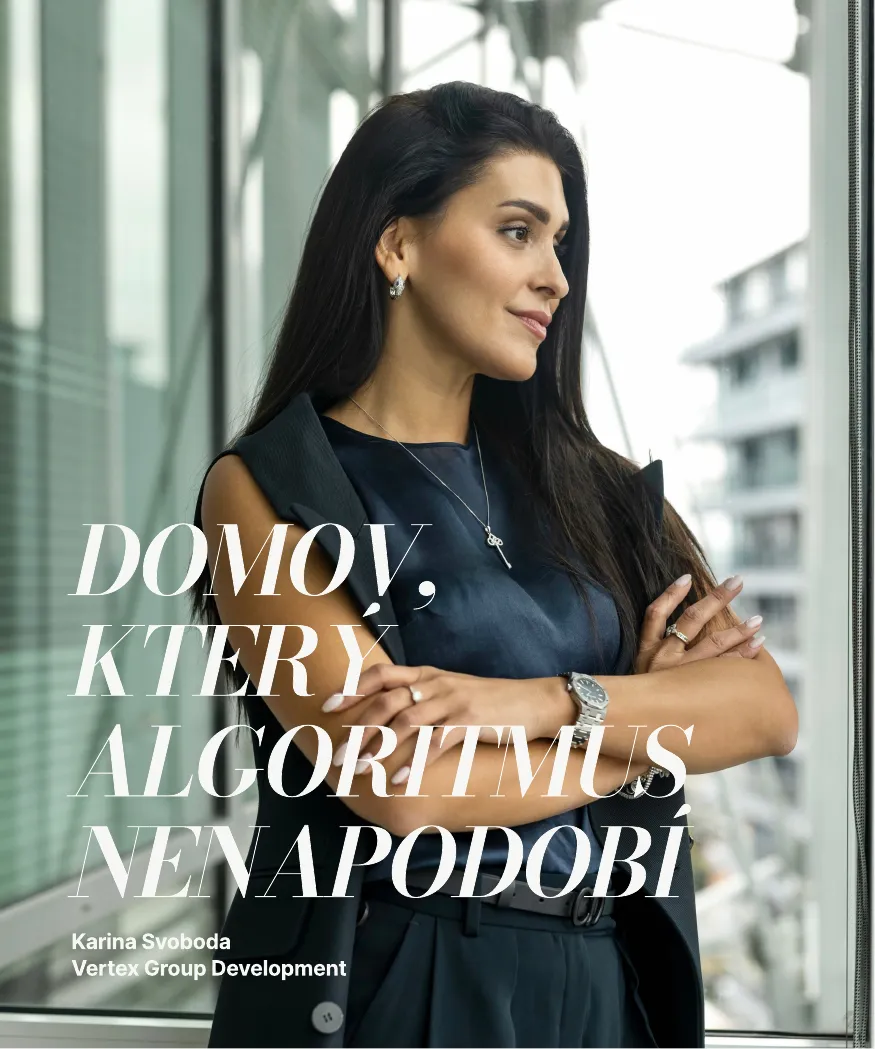
Karina Svoboda, Vertex Group Development
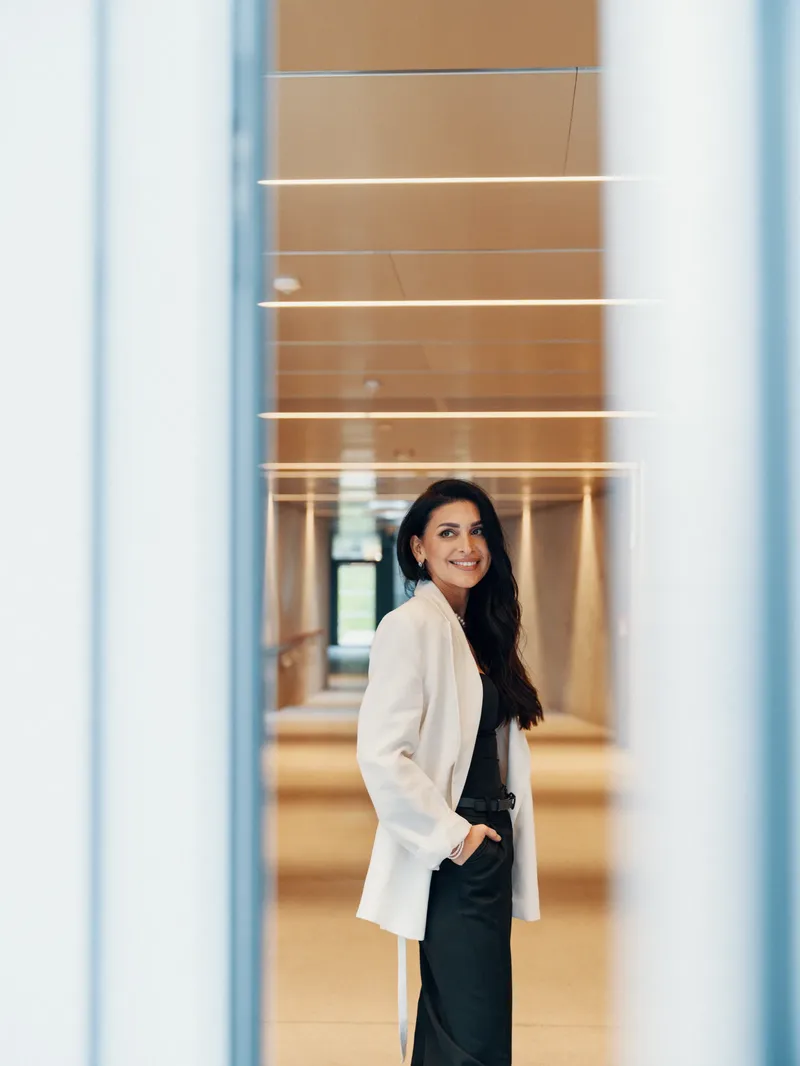
“Would you want to live this life once more, exactly as it was, and then once again, and again, for ever?”
Friedrich Nietzsche
Live it in such a way that you could answer Nietzsche: yes.
Karina Svoboda
Vertex Group Development
Artificial intelligence can already predict, with considerable accuracy, which apartment you will choose. It follows what you open, what you save, what you return to and where you gradually change your mind. From these individual traces it assembles a picture of our preferences – sometimes more accurate than one we could describe ourselves in a property search form.
But I am interested in a different question: will it ever be able to understand why we feel at home in a particular space? Not why we clicked on it or why it fits the budget, but why we naturally linger longer in one room, why we notice the morning light on a wooden floor, or why we keep returning to a certain painting for days after we first saw it.
It is precisely this less measurable layer of living that Vinorum 1905 Lifestyle is about. About light, scent, wood, glass, art, sound, books and the things that enter an interior gradually. A good home, in my view, is not created by one big purchase. It grows together with the person who lives in it.
When the apartment starts looking for you
Not long ago, on a property portal, we would enter the location, layout, price, square metres, balcony and lift. Today, search is moving towards hyper-personalisation.
AI systems evaluate what we look at, what we save and what we keep returning to. They therefore read not only the sentence “I want three rooms and a terrace”, but also less obvious preferences: that we are drawn to old buildings, that we linger over photographs of rooms with daylight, or that we are willing to compromise on size if the space has good proportions.
Ondrej Linda, Senior Director of AI & Engineering at Zillow, described this principle precisely some time ago: simply by browsing, saving and searching for properties, people naturally express their preferences, both explicitly and implicitly. Thanks to this, the system can offer them a house they would have missed in a conventional search.
Zillow has since moved further. Its systems work with a continuous memory of the user and are beginning to distinguish what is a long-term preference, what is merely a current interest and where a person is gradually changing their mind. The property portal is thus slowly turning from a catalogue into a partner in conversation.
A Czech presence in this world is, for example, Recombee, co-founded by Pavel Kordík, a company long devoted to recommender systems and personalisation. Its technology has also been used by the American platform Crexi, which focuses on commercial real estate and where personalisation already links the listings themselves, search, recommendations and the further steps leading to a transaction.
The Czech property market, too, may soon look different. Instead of a handful of technical filters, we will simply say: I am looking for an apartment ten minutes from Jiřího z Poděbrad, in an older building, with high ceilings, plenty of light and a quiet street; I will happily give up a balcony if there are beautiful original windows.
And the system will understand the difference between a wish and a genuine priority.
When the algorithm knows our taste all too well
This, for me, is where a more interesting debate begins. If an algorithm knows that I like blue glass, muted colours, vintage lamps and high ceilings, it can offer me hundreds of very similar variations within seconds.
Yet good taste does not arise merely from confirming what we already know.
Some years ago, the American writer Kyle Chayka described the phenomenon of AirSpace – the curious similarity of apartments, cafés and Airbnbs across continents. Social media has amplified this uniformity even further. The more we save the same aesthetic, the more the algorithm gives it back to us.
That is why I am increasingly interested in room for surprise. A painting I would never have chosen based on my history. An armchair that is not flawless, but holds the room together precisely because of it. A colour I would not have had the courage to pick from a sample book.
Taste, in my view, is not only the ability to choose correctly. It also takes a measure of courage to step outside what we already know to be safe.
My biohacking begins at home
We have grown used to associating biohacking with smartwatches, sleep apps or ice-cold water. Yet if we spend most of our lives inside buildings, the environment in which we wake up and fall asleep every day has a fundamental influence too.
Air, light, acoustics, temperature, materials, colour, scent and the amount of visual clutter are not merely a question of aesthetics. Together, they determine how we feel at home.
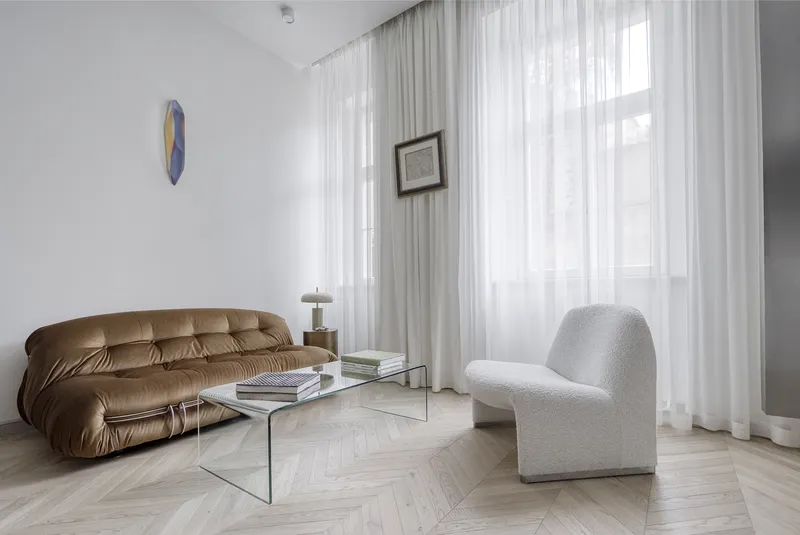
I love the ordinary moment in the morning when I step barefoot onto a natural oak chevron floor and the first light falls on it through a historic window. Nothing needs to happen – and that is precisely what makes it precious.
That is also why we gave light so much attention in the Vinorum 1905 Residence. I do not think about it only when the electrician needs to know where to put a spotlight. It belongs in the design from the very beginning, just like the layout, colour or proportions.
In this issue you will therefore also find a piece by Hynek Medřický, whom I call, with a touch of exaggeration, the guru of light. His approach to circadian principles is a reminder of one essential thing: light is not merely the means by which we see an interior. It is biological information that influences the rhythm of the day, alertness, sleep and the way our body prepares for rest in the evening.
You cannot draw scent into a floor plan
Similarly little is said in architecture about the sense of smell, even though it is scent that can, within a few seconds, open a memory of a particular place or period of life.
That is why I also enjoyed working with Aria Pura in Vinohrady, who complemented our building and the show apartment with scent. Which one we chose I will keep for your personal visit. After all, scent works best when it does not need to be explained in advance.
What has endured since 1905
During the reconstruction of Řipská, I was reminded once again what a strict critic of design time is. Some materials look perfect on the day of handover and beg to be replaced ten years later. Others have more than a century behind them, and one stands before them wondering whether we have truly moved forward in certain things.
One such moment, for me, was the original historic floor tiling of the 1905 building.
I did not want to stop at observing that it was old and beautiful, so we commissioned two expert surveys. One of the reports represented an investment of around CZK 50,000, but in a historic building especially, I consider it important first to understand what we have before us, and only then to decide.
It turned out that this was not a present-day ceramic tile with a thin surface pattern. The original material has a dense body approximately 15 to 17 millimetres thick, and the coloured decoration itself extends roughly four millimetres into its mass. The pattern is therefore not a print that wears away underfoot over time. It is a genuine part of the tile.
I was fascinated, too, by the manufacturing technique. The ornament was created using stencils, upside down; the individual colour layers were built up from fine mineral mixtures, and only then came pressing and firing. The tiling was designed as a composition, including borders and corner pieces, not as a randomly repeated pattern.
It is in moments like these that the word timelessness ceases, for me, to be a marketing term. Before you lies a material more than 120 years old, walked upon by generations of the building’s residents, and yet it still holds its character.
I do not want to copy such quality. I want to build on it.
That is why, in the Vinorum 1905 Residence, original tiling, a natural oak chevron floor, contemporary lighting, studio glass and vintage furniture can stand side by side. They need not come from the same period, but they should all pass the same test: will this still be beautiful several decades from now?
This, for me, is what respect for history means. Not imitating it, but continuing its quality.
Old things in a new interior
We might expect that, as the possibilities of AI grow, we will want ever newer furniture. In reality, vintage pieces, antiques and well-crafted objects with a clear provenance are returning to the finest interiors.
In my work on the Vinohrady apartment buildings around Jiřího z Poděbrad, my collaboration with Studio Lavish in Bratislava and Prague has proved invaluable in this respect.
I have no wish to turn a historic building into a retro stage set. I much prefer a single, precisely chosen vintage statement piece that enters a contemporary interior and brings with it another layer of time. An older armchair, lamp or side table has already lived through something, and it is precisely this authenticity that cannot be manufactured on demand.
I therefore do not use the past in an interior as a backdrop. I treat it as another material, one that can be worked with in the same way as colour, light or wood.
Art does not have to match the sofa
I apply the same principle to art. I would never want to begin with the sentence: we need something blue above the sofa.
Art should move a person and leave a trace.
In this issue, I therefore also recommend the work of Tereza Strnad. What I enjoy about her paintings is the way she combines shades we might hesitate to put side by side when looking at a sample book. But Tereza knows what she is doing, and it is precisely the tension between the individual tones that gives her paintings depth.
It may serve as a subconscious cue for a colour combination we would not have dared on our own.
And perhaps you will begin with a small painting. Perhaps the first piece of a collection for your child. It need not be large or showy; what matters more is whether it has the strength to stay with the family long enough for an object to become a story.
An empty apartment need not feel empty
In creating the layouts of the Vinorum 1905 Residence, I put into the project the best of what I have learned over more than twenty years in development – not only in the Czech Republic, but also in France, Spain and Monaco.
Every country has a different relationship to living, to colour, privacy or representation. Yet basic needs are surprisingly similar. We need somewhere to put our things, we do not want to be surrounded by visual noise all day, we need good light, pleasant materials, the right proportions and a colour composition that does not tire the eye.
We need a place for our keys, enough storage, a wall that can carry a painting – and sometimes also a piece of emptiness that does not have to be given a function straight away.
That is why I do not want a client, after taking over the apartment, to panic at the sight of empty walls and order an entire interior from a single catalogue over one weekend.
My aim is to prepare the space so well that it is pleasant even when almost empty. The natural oak chevron floor, historic proportions, a well-chosen colour, light, quality hardware and materials are meant to create a foundation that does not need to be covered up with decoration.
And then life can begin.
A library can take ten years to fill. You discover a painting on a visit to a studio, glass after a conversation with its maker, and a record player at the moment you realise you do not just want to hear music, but to devote an evening to it. Someone has an old armchair reupholstered; another object you bring back from a journey.
This is how an interior emerges that cannot simply be copied, because it was not created according to a trend, but according to the lives of the people who live in it.
Just as a masterpiece is painted, layer by layer.
A house whose story began in 1905
Vinorum 1905 could, of course, begin nowhere else than in the house itself, at Řipská 1322/13 in Královské Vinohrady.
Its story did not begin with our development project. It began in 1905, and for me it is important to respect that difference.
For a time, we have been given the opportunity to care for the house and to add another layer. Some things we are therefore repairing, others we are having made again in the traditional way, and elsewhere we consciously allow the present to enter.
Heritage sensitivity combined with contemporary execution.
Into this house I am putting not only my professional experience, but also energy, emotion and trust in a very loyal team of people around me.
And I would also like to thank our neighbours here. The reconstruction of a historic building in the heart of Vinohrady is not a romantic photograph from a construction diary. It means noise, dust, the comings and goings of craftsmen, traffic and a period in which the neighbourhood must show a great deal of understanding. I greatly appreciate their patience.
What you will find inside Vinorum 1905
This magazine is not a catalogue of the Vinorum Residence. It is my selection of people, things and ideas that influenced me while creating it.
Here you will find a piece by Hynek Medřický on circadian light, studio glass, art, vintage design, record players and sound, scent, new materials and century-old crafts. We will return to nature in the middle of the city and recommend publications and design objects that have a chance of outlasting more than one season.
We will also consider how to begin a small art collection for our children, and how to choose things that they themselves may one day wish to keep.
Running through the entire issue is a single question: how do you create a home that no artificial intelligence can precisely imitate?
I think that, in the end, the answer is not technological.
All it takes is to let your own life into it.
The Vertex Glossary
Throughout the publication you will also be accompanied by our little Vertex Glossary, which came about entirely unplanned. During meetings, I jot down in my leather notebook some of my colleagues’ sayings and quips, usually uttered in the middle of a situation that nobody finds particularly funny at the time.
Then I take the notebook on holiday, leaf through it and often laugh far more than at the moment the line was spoken.
Development is a serious discipline, but not so serious that we must take ourselves seriously all the time. So I am happy to share some of these lines with you, too.
I wish you pleasant reading, and I will be glad if you sometimes put the magazine aside for a moment, look around your own home and notice something you have long taken for granted.
Perhaps just a morning ray of light on the floor.
May Vinorum 1905 delight your eye, but also your touch, hearing, sense of smell and all the senses through which we truly perceive a home.
With love for all things beautiful, with respect and humility towards history,
Yours, Karina Svoboda
Vertex Group Development

Printed edition
Related articles
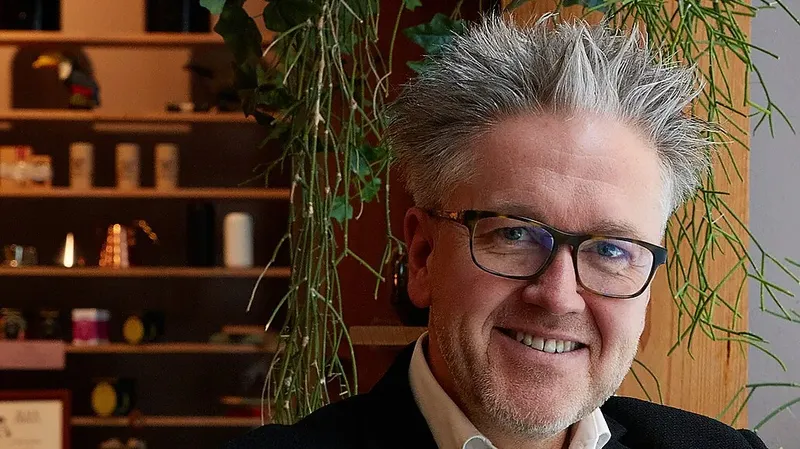 Light that respects peopleHynek Medřický reminds us that a good interior does not end with a beautiful light fitting.
 A hundred years underfootWhy historic floor tiles are one of the smallest details of a house — and at the same time one of the reasons Vinohrady holds its value.
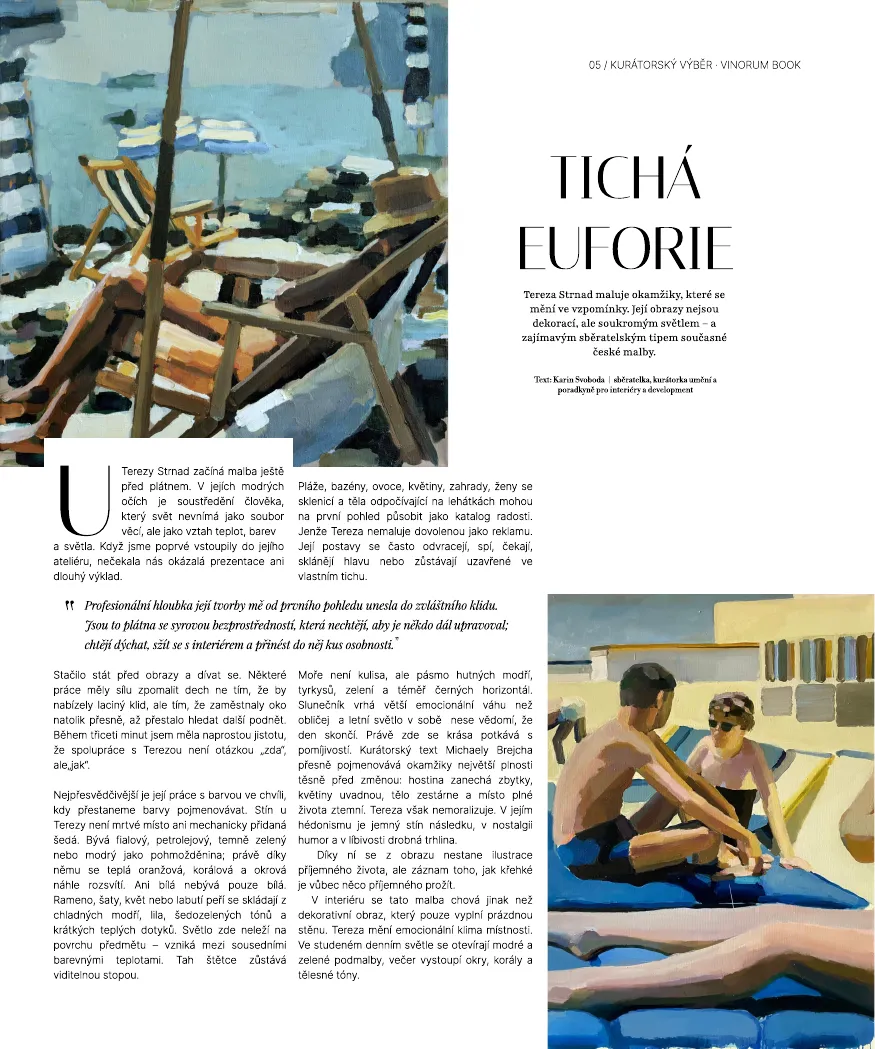 Quiet euphoria. Tereza StrnadWith Tereza Strnad, painting begins before the canvas. In her blue eyes lies the concentration of someone who perceives the world not as a collection of things, but as…